
Recap of the PSU, new signal transferring capacitors and new Output Stage.
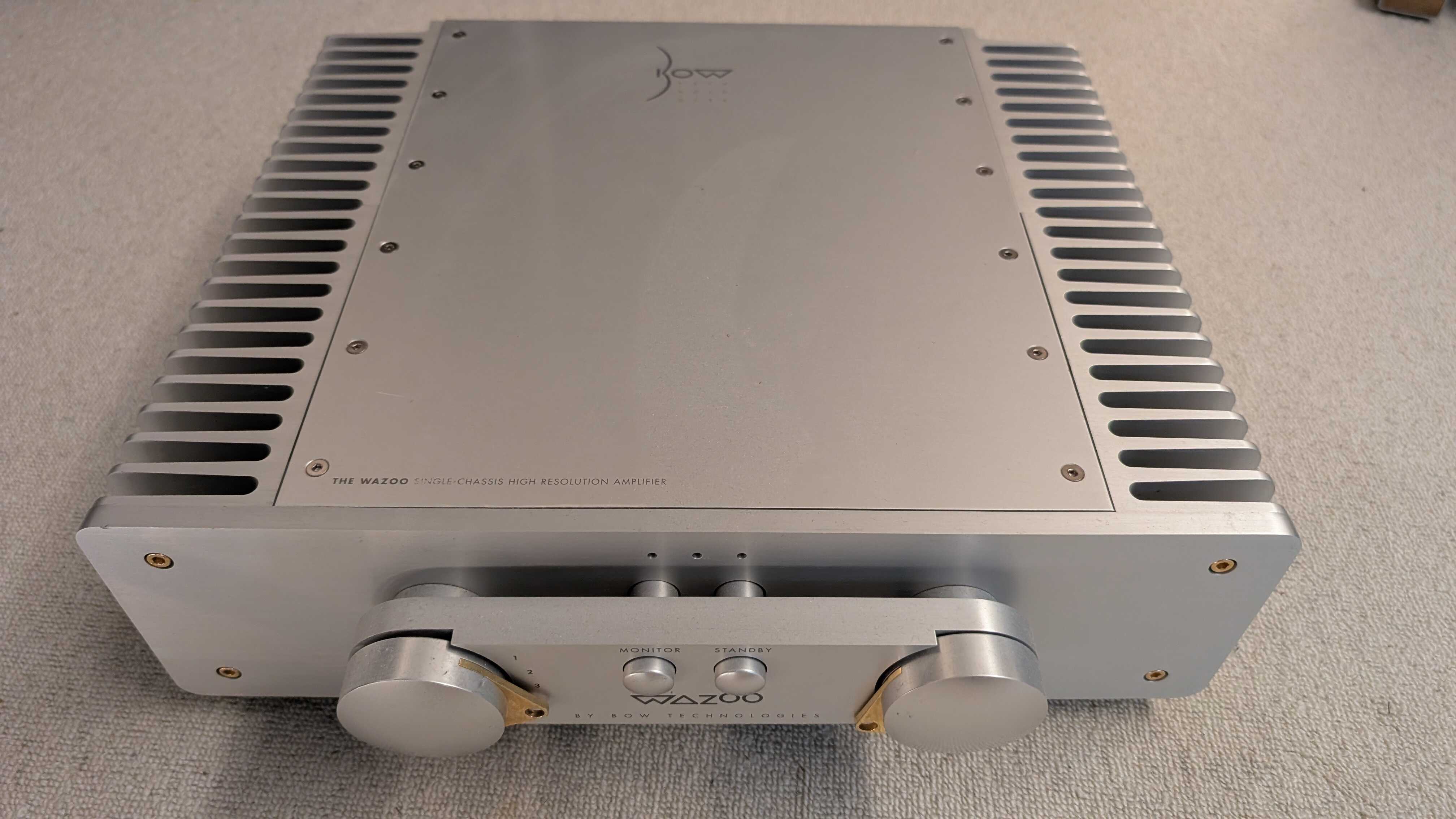
Give new life to your beloved vintage Wazoo amplifier and restore it to a "factory new" condition.
By replacing aged components with modern, high-grade equivalents, the lifespan of the amplifier is extended while significantly improving its sonic performance. The result is a fresher, more transparent soundstage that surpasses the original specs. During the upgrade, any existing faults or malfunctions are identified and corrected to ensure your amplifier returns to peak performance.Typical issues addressed in an aging Wazoo
A little technical description:
The design of the Wazoo amplifier was based on the ZZ-1 design, but with different MOSFET transistors in the output stage. While still inspired by classic tube circuitry, it features a voltage-controlled J-FET input in a cascode configuration with a high-voltage transistor. This input stage drives a MOSFET source-follower, which in turn drives a complementary MOSFET output stage. The entire signal path is elegantly simple, containing only five active components and operating entirely without global feedback. This zero-feedback construction ensures that the amplifier is capable of driving difficult loads, such as Magnepan or electrostatic speakers, without any problems.

Unfortunately, the Wazoo lacks a service hatch or modular access, so the only way to service the PCB is to remove the main transformer and disconnect all the wires in order to lift the large PCB out of the chassis.
Once this is removed, the metal parts can be carefully cleaned using a specialized cleaner and isopropyl alcohol.
All new components are carefully selected to preserve the original sonic balance of the amplifier. The input transistors are matched between the left and right channels and sourced from original New Old Stock (NOS). Upgraded output MOSFETs with improved performance characteristics are installed to enhance clarity and control.
The power supply is rebuilt using high-grade capacitors with superior specifications and an extended lifetime. In the signal path, premium Mundorf capacitors replace the original, aged components to ensure optimal audio quality.
These upgrades result in a more controlled, detailed, and transparent sonic presentation, while fully preserving the characteristic tube-like sound of the Wazoo.
One of the known issues is that the metal ground flange of the connector can break. This causes an audible hum in the audio output, or other forms of strange behavior.
Fortunately, they are easy to replace once the PCB is out of the amplifier, provided you have the right soldering tools.


With the new connectors, output MOSFETs, and capacitors installed, the PCB is ready to be reassembled into the chassis.
Fortunately, these components are easy to replace once the PCB is out of the amplifier, provided you have the right soldering tools.

After the upgrade, the amplifier undergoes a full adjustment and test procedure. The left/right channel output balance, as well as the input and output stage bias, are adjusted. Following this, a 30-minute full-power test into a low-impedance load will be executed to stress-test and heat up the amplifier, ensuring that the output stages are performing correctly.
Finally, the amplifier will go through a minimum 72-hour break-in test and a final listening test to ensure that all components are performing as expected.
For inquiries and service requests, please contact:
MoLIT Service
Email: Bow@MoLIT.dk